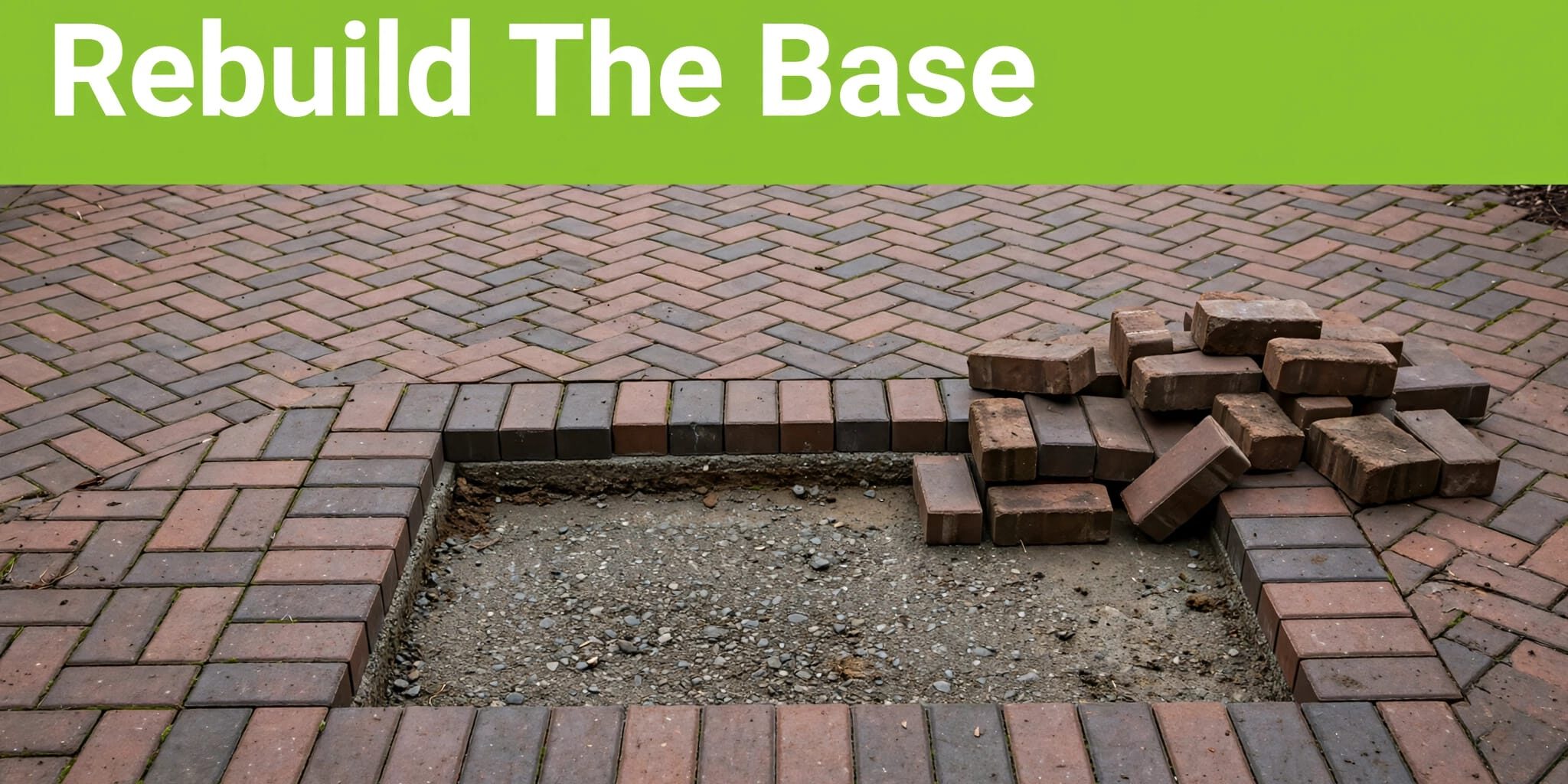
Sunken pavers may look like a problem with the bricks, but the trouble often lies underneath. If the same area settles after it has been leveled, rebuilding the support may be needed to stop it from sinking again.
The right repair depends on what has moved, how far the problem extends, and where water goes during a storm. We start with those questions before deciding whether to reset a few pavers or rebuild their support.
What the Pattern of Movement Can Tell You
A low spot is a reason to inspect the pavement, not proof that the entire patio needs replacing. The shape and location of the movement offer useful clues.
A single low spot
A small depression with tight joints and stable neighboring pavers may need only a spot repair. For localized paver patio repair, lift the affected units and check whether the bedding layer has shifted or the material beneath it has settled.
Look beyond the lowest paver. Include enough surrounding area to provide firm, level support. If you stop at the visible dip, the reset section may develop a noticeable edge or settle again.
Movement across several rows
Widening joints, rocking uneven pavers, and multiple low areas point to a broader support problem. A driveway that settles where vehicles turn needs particular attention because heavy loads return to the same area every day.
Check the border, too. When an edge restraint moves, outer rows can spread even if the pavers themselves are sound. If lifting a few units reveals soft soil, a shifting aggregate base, or recurring paver settlement, surface leveling won’t be enough.
Why a Paver Base Fails
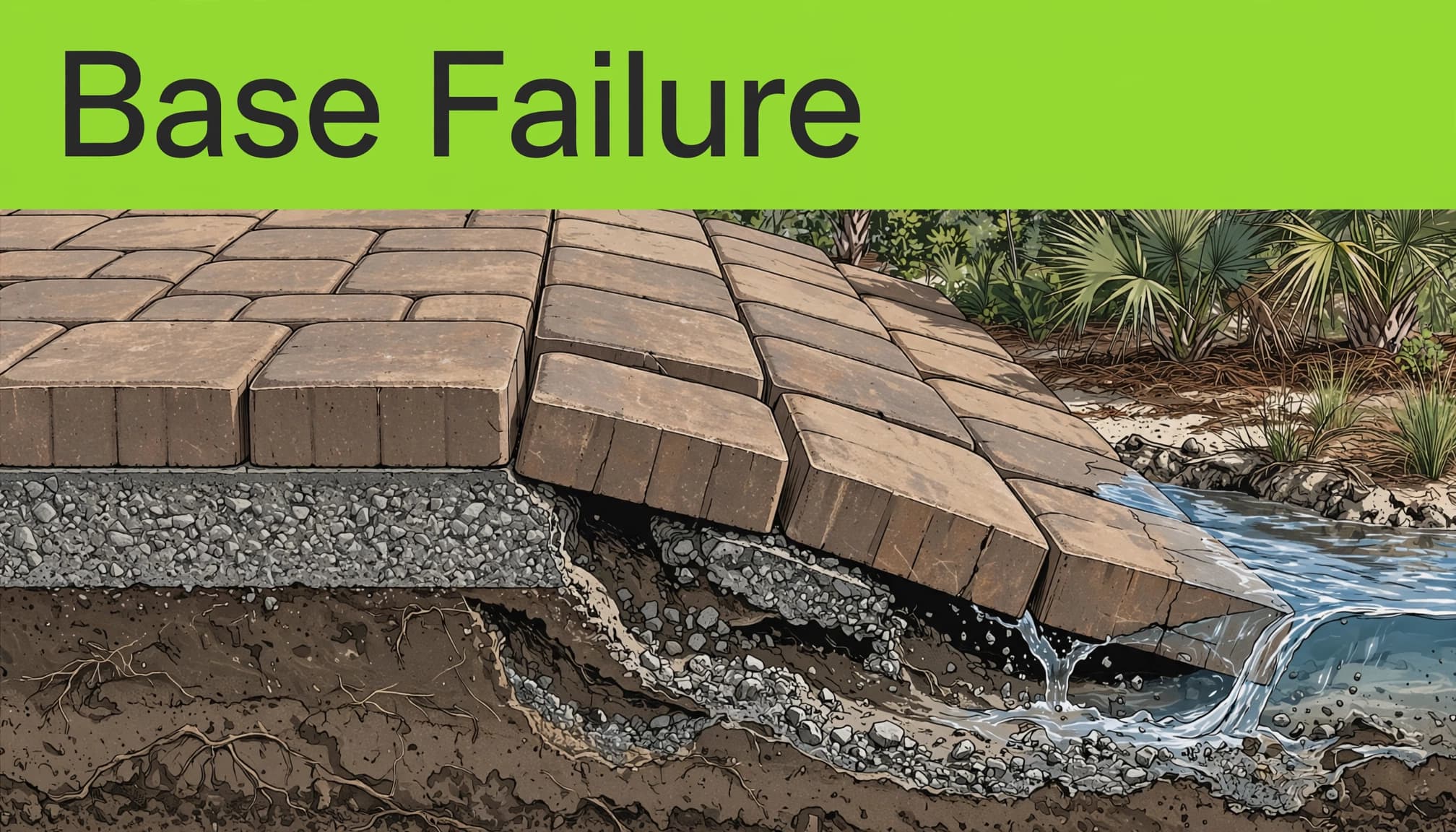
A paver surface relies on the soil below it, a compacted aggregate base, a bedding layer, and secure edges. The Concrete Masonry & Hardscapes Association’s pavement guidance describes how these parts work together. A defect in one part can show up as movement at the surface.
Water and weak soil
In Southwest Florida, heavy rain can quickly reveal drainage issues and lead to soil erosion. A downspout beside a patio, irrigation overspray, or runoff from higher ground can wash away soil or bedding material. Tree roots can also shift pavers, while saturated fill may lose support under repeated traffic.
Standing water doesn’t always mean the base has failed; a blocked outlet can cause ponding on an otherwise stable surface. We look for washed-out joint sand, exposed soil along the edge, and movement that returns after rain before recommending base work.
Compaction and perimeter support
Aggregate that wasn’t compacted consistently can settle under use, and freeze-thaw cycles may worsen movement in colder climates. The same applies when the soil beneath it is soft or disturbed, or when past paver installation left inconsistent support. Adding more bedding sand over a deep depression doesn’t repair either condition; a thicker sand layer can shift and leave another low spot.
Edge restraints hold the perimeter in place. Loose anchors, an eroded shoulder, or a border without firm support can let the pavers separate. Our guide to paver base compaction explains why the support beneath the visible surface matters, especially in vehicle areas.
When Paver Base Repair Requires Reconstruction
The clearest test is what you find after lifting the affected pavers. Reconstruction is warranted when the aggregate base is missing, soft, or poorly compacted, the subgrade soil is unstable, or support has repeatedly washed out. The repair should extend to stable material rather than stop at the edge of the visible depression.
These conditions call for different scopes of paver patio repair:
| What you find | Likely response |
|---|---|
| A few stable pavers with minor bedding irregularities | Lift and reset the local area with a spot repair. |
| A small area with settled or missing aggregate | Rebuild and compact the affected base. |
| Recurring paver settlement, soft subgrade, or several moving sections | Assess whether wider base reconstruction is needed. |
| Persistent runoff across the surface or along its edge | Correct the water path as part of the repair. |
A patio with one isolated defect may not need a full reset. If movement appears across much of the surface, rebuilding small patches one at a time can cost more without solving the underlying problem. A broader paver restoration may require structural repair below the surface. We inspect a representative area before recommending the larger job.
Fix the Water Source Before Resetting Pavers
Base reconstruction won’t last if drainage issues continue to remove support. Follow runoff during a storm when it’s safe. Check downspouts, irrigation heads, drains, planting beds, and the ground outside the paver border.
Keep runoff away from the repair
A downspout may need to discharge farther from the patio. A blocked drain may need clearing, while an eroded border may need grading so surface drainage carries water toward a suitable outlet. Our Florida patio drainage guidance covers the surface and perimeter signs worth checking.
Drainage work must suit the property. A channel drain, swale, or subsurface drain can help in the right location, but each needs an appropriate place to discharge. Moving water toward a neighbor, garage, or pool enclosure creates another problem. UF/IFAS also describes how rain gardens can manage runoff where the site has suitable space and conditions.
Protect the edges
Water flowing beside an unsupported edge can remove the soil that holds the restraint. The border then moves, joints widen, and jointing sand escapes, letting more water reach the base.
We check the edge restraints and the material supporting them together. Even a spot repair may require correcting its local water path. Fastening an edge into weak ground may improve its appearance briefly, but movement can return after heavy rain.
How a Failed Section Is Rebuilt
The repair process should follow the cause found during inspection. The goal is to restore firm support and the proper surface grade while keeping sound pavers where possible.
Remove material until the support is sound
The affected pavers are lifted and set aside for reuse if they’re in good condition. Bedding material is removed so the crew can inspect the aggregate base and soil beneath it. Loose fill, tree roots, and other unstable material must be addressed before the base is restored.
This is also the time to check nearby drains and edges. If the excavation reaches a utility line, pool feature, or building threshold, the repair needs a professional assessment before work continues.
Restore the base and finished surface
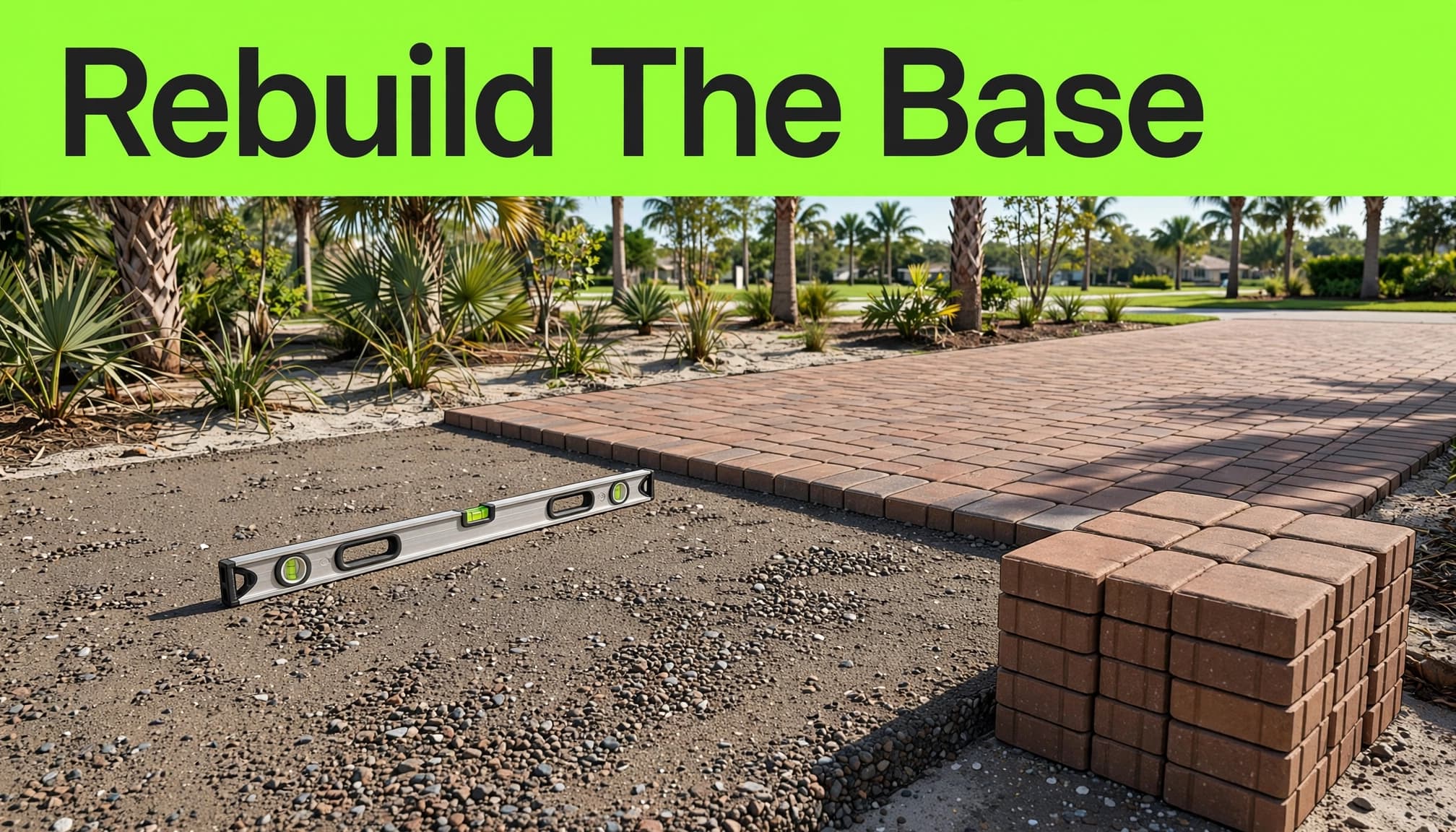
Suitable aggregate is placed and compacted in manageable layers, using a plate compactor as needed. The crew checks the grade as the base is rebuilt, so water has a planned route away from the structure. A consistent bedding layer then supports the reset pavers, keeping the paver restoration focused on lasting support.
The edge restraint is secured, and replacement pavers are used where needed. The joints are refilled with compatible jointing sand, also called joint sand. Final compaction and a surface check complete the work. Optional paver sealing can be considered for appearance or surface protection, but it isn’t required for structural stability. Our priority is a repair that meets the surrounding pavement smoothly and remains supported at its edges.
Decide Whether to Handle the Repair Yourself
A small, isolated patch of uneven pavers on a pedestrian walkway may be manageable as a spot repair. You should be able to lift them safely, inspect the support, and compact the area. You’ll need more than spare sand and a rubber mallet if the aggregate has settled.
We recommend professional help when pavers keep sinking, the soil feels soft, or drainage crosses the work area. Brick driveways and commercial areas paved with concrete pavers carry heavier loads. Poor compaction in a vehicle area can undo a careful-looking repair.
Pool decks, steps, garage transitions, and surfaces beside a building need close attention to finished height and drainage. If the cause isn’t clear after lifting a few pavers, or movement creates trip hazards, pause rather than cover it up.
What Professional Repair Costs Depend On
There isn’t a dependable price per square foot for every paver base repair. A small patch can cost more per square foot because lifting, excavation, compaction, and cleanup are still required. A larger job may also need drainage correction or replacement materials.
Compare written estimates by scope, not just the final number. Ask how much pavement will be lifted, whether aggregate and soft soil will be removed, and how the new base will be compacted. The estimate should also cover edging, runoff, joint sand, disposal, and any pavers that can’t be reused.
Access affects the price. Work behind a screened lanai may require more handling than the same repair beside an open driveway. For paver patio repair, a clear quote should distinguish a spot repair or simple reset from reconstruction, so you know which problem the proposed work will solve. Treat paver sealing as a separate optional service, not part of base reconstruction.
Keep Small Problems From Becoming Larger Repairs
After heavy rain, look for fresh low spots, missing joint sand, and soil washing out beside the border. Address a misdirected downspout or loose edge while the affected area is still small.
Routine brick paver maintenance helps you spot movement early and see when broader wear may call for paver restoration. Cleaning and paver sealing can improve appearance, but neither corrects a failed base. Aggressive pressure cleaning can remove joint sand, so check the joints afterward and replace missing jointing sand.
A chipped unit is a different problem from settlement. Minor edge wear may only need cleaning if the paver remains sound and safe underfoot. A badly chipped or cracked unit can often be replaced with a matching one. If several units crack or rock in the same area, inspect their support before treating them as separate cosmetic repairs.
Key Takeaways
- Repeated sinking, soft soil, missing aggregate, and several moving rows call for a closer look beneath the pavers.
- Bedding sand can correct minor setting differences, but it can’t replace a failed aggregate base.
- Drainage and edge support must be repaired alongside the low area when they caused the movement.
- Sound brick pavers can often be reused after the base is rebuilt.
Frequently Asked Questions
Can sunken pavers be repaired without rebuilding the whole patio?
Yes. If settlement is limited to one area and the surrounding base remains firm, a localized repair may be enough. We lift beyond the visible low spot to find stable support before setting the pavers back in place.
Why did the same low spot return after leveling?
The earlier work may have corrected the bedding layer without correcting settlement below it. Water may also still be washing material away. Repeated movement is a good reason to inspect the aggregate, subgrade soil, and nearby drainage.
Will polymeric sand stop pavers from sinking?
No. It can help fill and stabilize the joints, but neither it nor jointing sand can support a weak foundation. The CMHA maintenance guide for interlocking pavement treats upkeep and restoration as separate needs. Correct the base first, then refill the joints with material suited to the pavers.
A Repair That Holds Starts Beneath the Surface
A low paver is easy to see. The condition that caused it takes more care to identify. We look at the base, edges, and water flow together, then recommend a repair that fits the area affected.
If your patio, walkway, or driveway keeps settling, Contact Us for a FREE Quote. Firm support and controlled drainage are what keep a level surface from becoming another repeat repair.